> For the complete documentation index, see [llms.txt](https://docs.aisera.com/llms.txt). Markdown versions of documentation pages are available by appending `.md` to page URLs; this page is available as [Markdown](https://docs.aisera.com/overview-of-aisera/getting-started-guide/setup-your-aisera-tenant.md).
# Setup Your Aisera Tenant
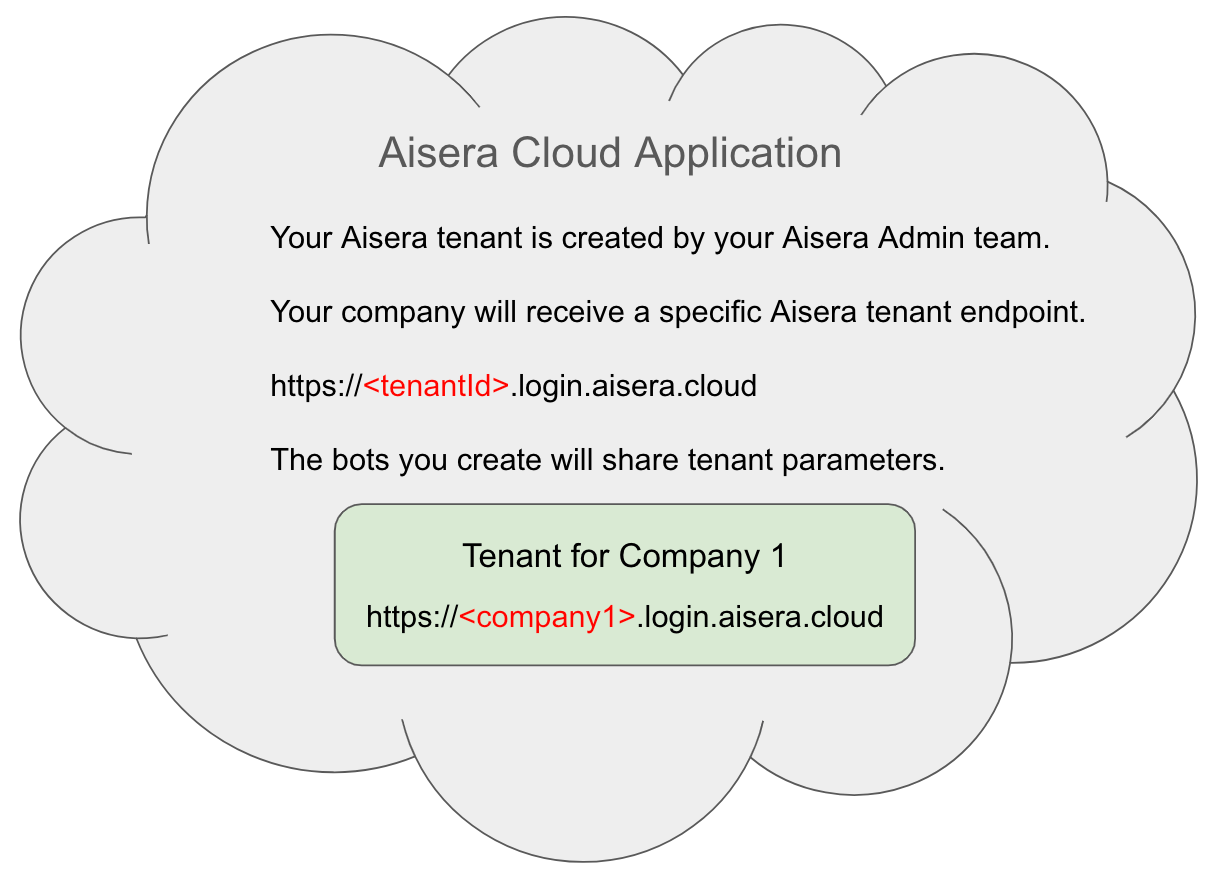
Each Aisera customer has an instance of the Aisera Gen AI Platform, called a **Tenant**. Each tenant runs in the Aisera Cloud, and each tenant has a separate URL address. This tenant will be accessed through the **Vanity** **URLs** provided to you by Aisera.
The Aisera Gen AI Platform uses a **multi-tenant architecture**, which means that for each customer, there is a separate container with server software, a temporary data store , and some shared processing modules.
Your Aisera Team will assign you a **Tenant ID** that will define your tenant instance.
Use the **Tenant ID** when you log into your Aisera Gen AI Platform instance.
Aisera Tenant Instance
## Multiple Bots Per Tenant Instance
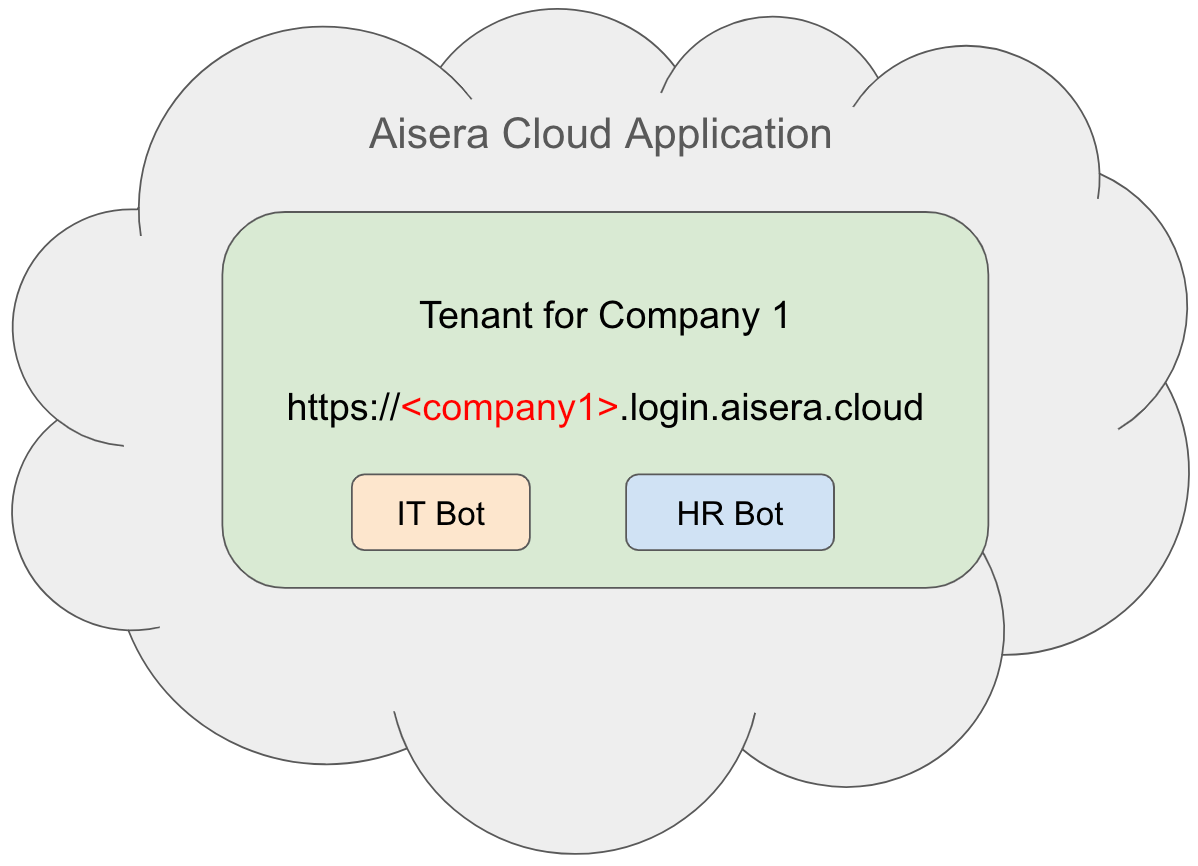
Many companies create a single bot for a single purpose that uses the resources of their tenant. But you can create multiple bots for your company tenant instance. For instance, you may want an IT bot to help with IT requests, and an HR bot to help with HR requests.
Multiple Bots per Tenant Instance
Bots will share tenant parameters, but each bot has its own **Bot ID** and unique parameters.
## Universal Bot
If your company wants to use more than one bot, you can create separate bots or create a **Universal Bot** that connects them.
## Adding Data to your Tenant
To connect a Data Source with your Aisera Tenant Instance, you need to perform these connector steps:
1. Create an **Integration** with your Aisera Tenant (provide authorization)
2. Include your **Integration** in a **Data Source c**onfiguration (data from your Enterprise application)
3. Associate the **Data Source** with an **Aisera Application/Bot**. This is one of the steps you will perform when you get to the Build-a-Bot stage.
### Integrate a Data Source with Your Tenant
The Aisera term **Integration** means to create a way for either an Aisera Admin user to log onto your data source and bring data to the temporary data store on your Aisera tenant, or for an Admin user of your data source to log onto your Aisera tenant and transfer data to the temporary data store on your tenant.
Setting up the authentication credentials for this exchange is known as **Creating the Integration**.
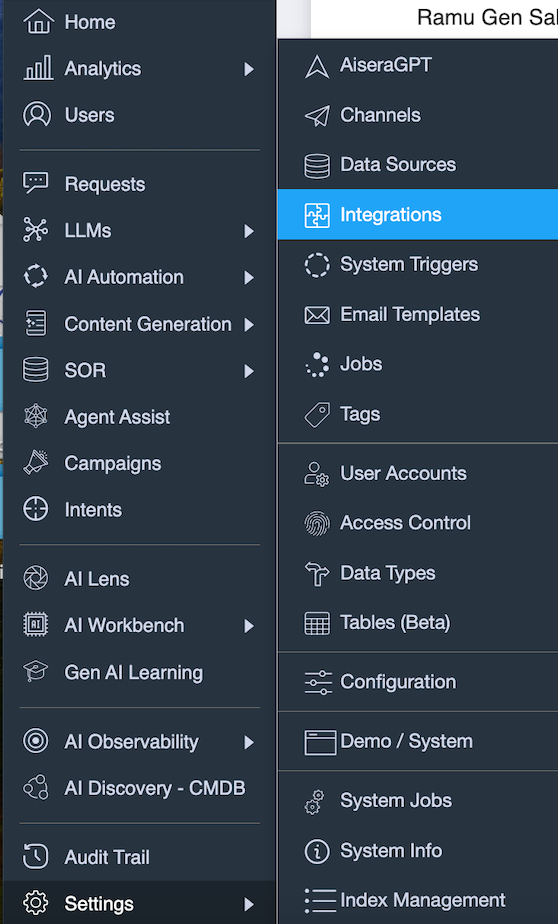
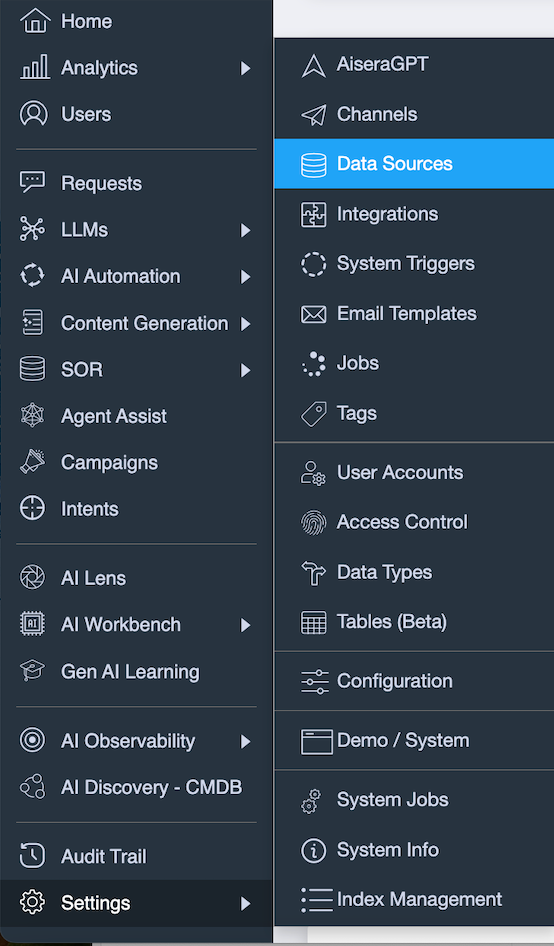
To begin, navigate to **Settings > Integrations** in your Aisera Admin UI and you will see that many commercial sources are pre-mapped to the Aisera Platform.
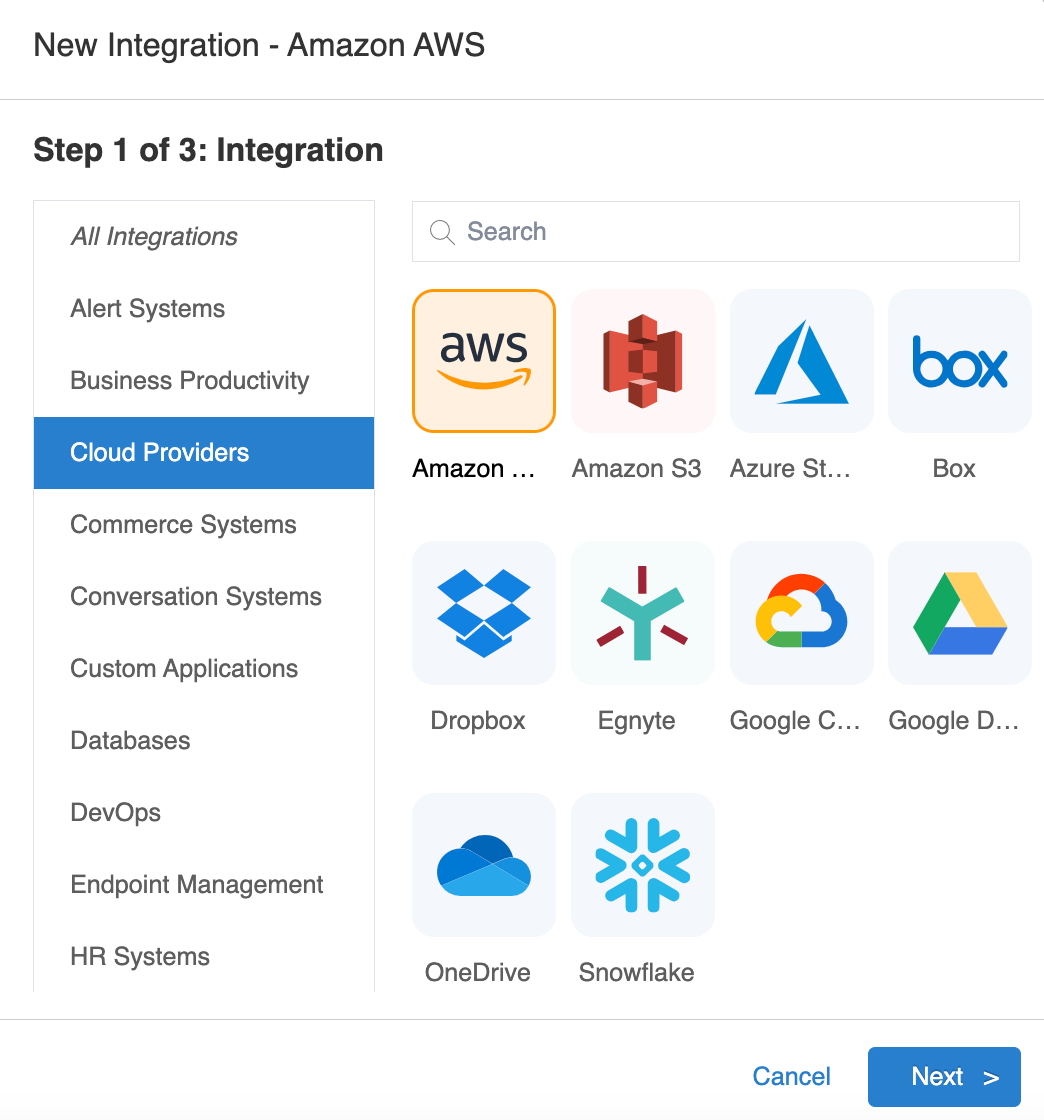
Choose the **+ New Integration** button in the upper-right corner of the **Integrations** window. \
The **New Integration Search** window allows you to choose our list of pre-mapped external data sources by category, like **Cloud Providers** or by Enterprise application name.
Step-by-step instructions to connect many of these sources is documented [here](/aisera-platform/adding-data-to-your-tenant/integrations-and-data-sources/connectors.md). If the source you're connecting to is not documented yet, find out the authentication type you need to use, and follow [these general instructions](/aisera-platform/adding-data-to-your-tenant/integrations-and-data-sources/learning-functions-for-external-data-sources/generic.md).
### Add the Integration to a New Data Source
Now you need to include this new Integration in a New Data source (Enterprise application) that you add to your Tenant configuration.
Navigate to **Settings > Data Sources** in your Aisera Admin UI.
Choose the **+ New Data Source** button in the upper-right corner of the **Data Sources** window. You will see the same list of pre-mapped external data sources.
The **New Data Source Search** window allows you to choose from the same pre-mapped external data sources by category, like **Cloud Providers** or by Enterprise application name. Make sure that you choose the same source for your Data that you chose for your Integration (they must match, because they are two pieces of the same connection). For instance, if the Enterprise application that your company uses to track Tickets and Knowledge Articles is Salesforce, *chose Salesforce for your new **Integration**, and your **Data Source**.*
If the source you want to add is not in the **Settings > Data Source > + New Data Source** list, you can use a [**Generic** **Integration**](/aisera-platform/adding-data-to-your-tenant/integrations-and-data-sources/using-the-generic-connector.md) and then use [**Field Mapping**](/aisera-platform/adding-data-to-your-tenant/data-ingestion.md#field-mapping).
#### Map Enterprise Data to your Aisera Platform
The term Data Source for the Aisera Gen AI Platform is usually the Enterprise application that your company uses to create shared information, such as Tickets or Knowledge Base Articles that the Aisera platform will ingest and keep in temporary storage.
A few of the common Enterprise software sources that our customers use are Salesforce, ServiceNow, Zendesk, and Confluence.
#### Mapped Fields
The term Mapped Fields in the Aisera Gen AI Platform means that there is a software map where the Aisera Gen AI Platform, your Aisera Team, or you (with the Aisera Admin UI) have created a one-to-one correspondence between the fields in the Aisera Gen AI Platform's **Data Model** and the fields in your Ticket or Knowledge Tools.
For instance, if you plan to use Tickets from your Salesforce tool as a source of information for your bot responses, then you need to create an Integration for your Salesforce instance so you can ingest the data from the Tickets table and the other tables in Salesforce that are related to the Tickets table (to make a complete Ticket).\
\
Then you will Add a Salesforce Data Source to your tenant, and this will connect the pre-mapped Salesforce fields with the fields in the Aisera Gen AI Platform so that the data can be transferred to the temporary data store on your tenant instance.\
\
The example below displays the names of Aisera Knowledge Base Article fields on the left side and the corresponding Salesforce fields for Knowledge Base Articles on the right.
Data Source Mapped Fields
You can see the table above on the Data Source Details page of the Aisera Admin UI after you run a Data Ingestion Job, as described below.
#### Ingest the Data
After you have mapped your Data Source with the Aisera Gen AI Platform fields (either using the Aisera Admin UI or with a JSON file), the data will automatically be ingested when your Data Source configuration is complete.
If you need to run a Data Ingestion Job manually, use the triangle button at the top of the Data Sources window to copy the data from your source to your Aisera tenant.\
\
This completes the Connection for your Tenant!
### Associate the Tenant Data Source with a Bot
The last step in the data connection process is associating the Data Source with your Bot. You can do this any time AFTER you run a Data Ingestion Job, but BEFORE you complete your Bot configuration.
After you have performed the initial steps of bot creation, choose the
Associated a Data Source with Your Bot
button to associate the tenant data source with your bot.
Choosing the tenant data source for your bot allows the bot to use the data from the connected source.
#### Complete the Tenant Setup by Adding Channels
Adding channels to your tenant is that last thing you have to do before you start to build your application/bot. You can perform this step at the beginning, or come back and do it later.
## Tenant Configuration Options
There are many tenant configuration options in the Aisera Gen AI Platform. If you suspect that something in your tenant configuration is not set correctly, you can check the [**Tenant Configuration Options**](/aisera-platform/tenant-setup/aisera-platform-configuration/tenant-configuration-settings.md).